How to Tell If a Property Is Overpriced Before You Make an Offer
Am I getting ripped off?
It’s a valid fear. The market is a rollercoaster, and sellers are often more than happy to let you pay for their memories rather than the actual bricks and mortar.
Here’s one thing most new buyers forget. Don’t be one of them. They forget that a listing price is just a number a human being made up—it’s not a law of nature. Skip the feelings when you’re house hunting. Look at the numbers instead. This keeps you from getting ripped off.
Learn how to tell if a property is overpriced before you make an offer.
Is That Property Overpriced?
Honestly, finding out if a property is overpriced isn’t about being a math genius. It’s about being a bit of a detective. You’re looking for the gap between what the seller wants and what the market will actually allow.
If you walk into a deal blindly, you’re not just overpaying today; you’re losing equity tomorrow. Let’s make sure that doesn’t happen.
How Do I Know if a Property is Fairly Priced?
When you’re standing in an open house, it’s easy to get distracted by the staging. But here is how you check the pulse of the price tag quickly:
- Look at the comparables: Check homes within a half-mile radius that sold in the last 90 days.
- Compare the “Per Square Foot” Cost: Divide the price by the living area and see if it aligns with the neighbors.
- Check the “Days on Market”: If it’s been sitting for 40 days while others sell in 10, the price is the problem.
Think about it this way: if every other house on the block is a Php4,000,000 house, and this one is Php5,500,000 it better have a gold-plated roof.
Check The Asking Price And List Price
You need to understand the asking price and the list price first. It’s how you figure out if a property costs too much before you make an offer. These prices show what the seller thinks the home is worth. But they don’t always match what it’s actually worth. You have to look at recent market data and trends to make a smart decision.
What is the Asking Price vs. List Price?
While often used interchangeably, the asking price refers to the price the seller is currently requesting, and the list price is the price at which the property was originally listed. It’s important to track both:
- Asking Price: This can change during the time the home is listed because of negotiations or if the seller decides to adjust it.
- List Price: This is the first price set when the home is put on the market.
Compare these two. You’ll spot price adjustments right away. And that tells you something important. It shows if the seller is flexible. Or maybe desperate. These are key telltale signs when you’re looking at a pricing strategy.
How to Analyze Asking and List Price History
1. Review Listing History
Start by gathering the property’s listing history from MLS data or public real estate websites. Look for:
- Sudden large price increases: These may indicate the seller is testing the market or has unrealistic expectations about the home’s perceived value.
- Price reductions: Multiple price cuts often suggest the home was initially overpriced and the seller is trying to attract more potential buyers.
- Price stability: A stable asking price over several months could mean the seller is firm on their price, which might be a red flag if the home is not attracting interest.
2. Compare to Recent Comparable Sales
Look at what similar homes sold for recently in the same area. You want to see if the asking price makes sense with market trends. That’s where you need a comparative market analysis (CMA). A CMA compares:
| Feature | Subject Property | Comparable 1 | Comparable 2 | Comparable 3 |
|---|---|---|---|---|
| Size (sq ft) | 2,000 | 1,950 | 2,100 | 2,050 |
| Bedrooms | 3 | 3 | 3 | 4 |
| Bathrooms | 2 | 2 | 2 | 2 |
| Sale Price | — | Php4,000,000 | Php4,200,000 | Php4,150,000 |
| Price per sq ft | — | Php2,051 | Php2,000 | Php2,024 |
If the asking price per square foot is significantly higher than these comps, it may be a red flag indicating overpricing.
Do Your Homework on Pricing
Many homeowners set prices based on feelings or how much they spent on upgrades. But that doesn’t mean buyers will pay more. Here’s why you need to check prices carefully:
- Watch for inflated prices: Some sellers price high and expect to come down later. But buyers aren’t dumb. They can spot overpriced homes.
- Know the market: In a seller’s market, homes sell fast even if priced a bit high. In a buyer’s market, overpriced homes just sit there.
- Get expert help: A good real estate agent knows the local market. They can tell you if the price makes sense based on what similar homes sold for and how the market’s doing.
Summary: What to Look For in Asking and List Prices
| Indicator | What It Means | Action To Take |
|---|---|---|
| Price significantly above comps | Possible overpricing | Investigate further, request CMA |
| Multiple price reductions | Seller adjusting to market feedback | Consider negotiating a lower offer |
| Price increases during listing | Seller testing the market or unrealistic expectations | Be cautious, verify with the agent |
| Stable high asking price | Seller is firm on price | Assess if the price aligns with the market |
| Asking price close to comps | Price likely fair | Proceed with detailed inspections |
By carefully examining the asking price and list price history, and comparing them to recent comparable sales and local market trends, you equip yourself with the knowledge to avoid overpaying. This essential step in your home search process helps ensure you make a fair offer that reflects true market value and protects your investment.
Compare With Comparable Homes And Similar Properties
Want to know if a house costs too much? Compare it with similar homes nearby. This helps you figure out what the house is really worth. And it stops you from paying too much.
What Are Comparable Homes?
Comparable homes are “comps.” They’re houses that look like the one you want to buy. They should match in these ways:
- Size (square footage)
- Age and condition
- Number of bedrooms and bathrooms
- Location and neighborhood
- Amenities and upgrades
Comps show you what people actually paid for similar houses. This gives you a real idea of what your house should cost.
How to Gather Comparable Homes
Find three comparable homes that sold recently. Look for sales from the last 90 days. Here’s how to find them:
- Use MLS Filters: If you can access the Multiple Listing Service, search for recent sales near your house. Filter by size, age, and condition.
- Public Records and Listing Sites: Check real estate platforms online. They show sold prices and details. You can see photos and the price per square foot.
- Ask Your Real Estate Agent: A good agent can make a Comparative Market Analysis (CMA) for you. They know how to pick the right comps.
Adjusting Comparable Prices for Accurate Comparison
Houses are never the same. So you need to adjust the numbers. Start with square footage:
- Find the price per square foot for each comp. Divide the sale price by the size.
- If a comp is bigger or smaller than your house, adjust its price. This shows what it would cost if it matched your house size.
Here’s an example:
| Comparable Home | Sale Price | Size (sq ft) | Price per Sq Ft | Adjusted Price for 2,000 Sq Ft |
|---|---|---|---|---|
| Comp 1 | Php4,000,000 | 1,950 | Php2,051 | Php4,102,000 |
| Comp 2 | Php4,200,000 | 2,100 | Php2,000 | Php4,000,000 |
| Comp 3 | Php4,150,000 | 2,050 | Php2,024 | Php4,048,000 |
Find the middle adjusted price per square foot. This gives you a good idea of the home’s value.
Why This Matters: The Role of Comps in Pricing Strategy
Comps help you avoid mistakes:
- Overpaying: If the asking price is way higher than similar houses, the house costs too much.
- Missing Out on Good Deals: If a house costs less than comps, it might be a bargain. Or it might have problems. Either way, you’ll know.
- Negotiation Leverage: Show comp data when you negotiate. Sellers might have set a higher pricebased on feelings, not facts.
Additional Factors to Consider When Comparing Properties
Size and price matter most. But other things affect value too:
- Location: Even in the same neighborhood, location matters. Schools, parks, and busy roads change prices.
- Condition and Renovations: New kitchens and bathrooms cost more. Old, broken stuff costs less.
- Market Trends: Know if it’s a buyer’s market or a seller’s market. This changes how houses are priced.
- Days on Market: Houses that sell fast at full price mean a strong market. Houses that sit too long might cost too much.
Summary Table: Key Steps to Compare with Comparable Homes
| Step | Action | Purpose |
|---|---|---|
| Gather 3 Comparable Homes | Use MLS, public records, and agent CMAs | Find similar recently sold homes |
| Match on Size, Age, Condition | Filter comps based on key property features | Ensure apples-to-apples comparison |
| Adjust for Square Footage | Calculate price per sq ft and adjust prices | Normalize price differences |
| Calculate Median Price | Determine the median adjusted price per square foot | Establish a fair market baseline |
| Analyze Additional Factors | Consider location, condition, and market trends | Refine valuation with qualitative insights |
Compare your house with recent sales. This homework helps you figure out if the asking price makes sense. Or if someone’s trying to charge too much. Do this before you make an offer. It stops you from making expensive mistakes.
Research the Local Market and Real Estate Trends
Knowing about the local real estate market and current market trends is an important step before you make an offer on a property. This helps you see if the asking price matches what homes are really worth and stops you from paying too much. It also gives you confidence and a good plan for negotiating. Below, we explain the key parts of market research and how they can help you decide.
Analyze Recent Price Movement in the Neighborhood
One of the most telling indicators of whether a property is overpriced is how house prices have shifted recently in the same area. To do this effectively, focus on:
- Price Trends Over the Last 3-6 Months: Check if prices have been going up, down, or staying the same. For example, if prices have steadily gone up by 5% in the last few months, a higher asking price might be okay. But if prices are flat or falling, be careful.
- How Much Prices Have Changed: Even small changes can affect your investment. If prices dropped by 3% in three months, the asking price might be too high.
- Outside Factors Affecting Prices: Things like changes in interest rates, local jobs, or new businesses can change home prices. For example, if a big company moves into the area, prices usually go up.
Use tools like local government housing reports, real estate analytics platforms, or consult your real estate agent for accurate data on neighborhood price trends.
Assess Average Days on Market (DOM)
The average days on market show how fast homes are selling in a neighborhood. This number can help you see if a property is priced incorrectly or if there are other reasons buyers aren’t interested.
- Comparative DOM Analysis: If most homes nearby sell within 10-15 days, but the property you’re interested in has been listed for 40 days or more, this is a clear warning sign. It usually means the asking price is too high or there might be hidden problems with the home.
- Market Speed as a Buyer’s Signal: In fast markets where homes sell quickly, sellers often get multiple offers. When a home takes longer to sell, buyers may have more power to negotiate a better price.
- Seasonal Effects: Remember that the housing market changes with the seasons. For example, homes usually sell faster in spring and summer. So, it’s best to compare the days on market to the same time in past years for a clearer picture.
Determine Buyer’s vs. Seller’s Market Dynamics
Knowing whether you’re operating in a buyer’s market or a seller’s market is essential for crafting your offer and negotiation strategy.
- Seller’s Market: When there are more buyers than homes, houses usually sell quickly and often for more than the asking price. Sellers have the upper hand and may list homes at or above what they think the home is worth.
- Buyer’s Market: When there are more homes for sale than buyers, houses may stay on the market longer. Sellers might accept offers below the asking price to avoid having the home sit unsold. Buyers have more power to negotiate.
- Market Signs: Check how many homes are for sale, how often homes sell for more than the asking price, and how many homes get several offers. For example, if homes often sell for more than the list price, it’s a seller’s market.
Understanding these factors helps you see how much power you have in negotiations and whether to offer less, the same, or more than the asking price.
Practical Tools and Data Sources for Market Research
To conduct thorough market research, leverage a combination of online tools, professional insights, and public data:
| Data Source | Purpose | How to Use |
|---|---|---|
| MLS (Multiple Listing Service) | Access to recent sales and listings | Filter by the same size, location, and date |
| Online Valuation Tools (Zillow, Redfin) | Quick estimate of property values | Compare with the asking price for discrepancies |
| Local Government Reports | Official housing market statistics | Review price trends and DOM data |
| Real Estate Agent Expertise | Personalized market insights and CMAs | Request a detailed comparative market analysis |
| Economic Indicators | Understand broader market influences | Monitor interest rates, employment trends |
Summary Table: Key Market Research Metrics to Evaluate Before Making an Offer
| Metric | Description | What It Tells You | Ideal Indicator |
|---|---|---|---|
| Price Movement (%) | % change in home prices over recent months | Market trend direction | Stable or rising prices |
| Average Days on Market (DOM) | Average time homes stay listed before selling | Market demand and pricing accuracy | DOM close to or less than the neighborhood average |
| Sale-to-List Price Ratio | Final sale price as % of list price | Seller’s market strength | Ratio near or above 100% |
| Inventory Levels | Number of homes for sale | Supply-demand balance | Low inventory favors sellers, high inventory favors buyers |
| Number of Multiple Offers | Frequency of properties receiving multiple bids | Buyer competition level | A high number indicates a seller’s market |
Why This Step Matters in Your Home Search
Conducting detailed research into the local market and real estate trends equips you with the knowledge to:
- Identify Overpriced Properties: By comparing price trends and DOM, you can spot listings that are out of sync with the market.
- Understand Your Negotiation Position: Knowing market dynamics helps you decide whether to make a competitive offer or negotiate aggressively.
- Avoid Emotional Decisions: Data-driven insights keep you grounded, preventing overpaying based on excitement or seller pressure.
- Save Time and Money: Focusing your home search on properties priced appropriately for the market reduces wasted effort and potential financial loss.
Mastering market research is an important skill every buyer should learn before making an offer. This knowledge helps you avoid paying too much and makes you feel confident about your purchase.
Ask An Estate Agent About Pricing Strategy
Your real estate agent is your best resource when it comes to understanding pricing. They have access to market data and can give you expert advice on whether a home is fairly priced.
1. Ask How They Arrived at the Asking Price
Don’t be shy, ask your agent to explain the logic behind the asking price. Did they use a comparative market analysis (CMA)? Did they consider recent sales of similar properties in the same area? Understanding this helps you know if the price is based on solid data or just seller emotion.
2. Request Evidence of Comparable Homes Used in Pricing
Ask for a list of recent sales the agent used to set the price. This should include details like size (square footage), number of bedrooms, condition, and sale price. Seeing this data side-by-side helps you spot if the asking price is out of line.
3. Inquire Whether the Seller Expects Negotiation Room
Some sellers list their homes at prices 5-10% above what they’re willing to accept. Knowing if the seller expects to negotiate can help you plan your offer strategy. If the seller is firm, you may need to offer closer to the asking price. If they’re flexible, a lower offer might be accepted.
Signs a Home Is Overpriced: What to Watch For
Knowing the telltale signs of an overpriced home helps you avoid costly mistakes and negotiate smartly. Here are the key indicators to recognize before making an offer:
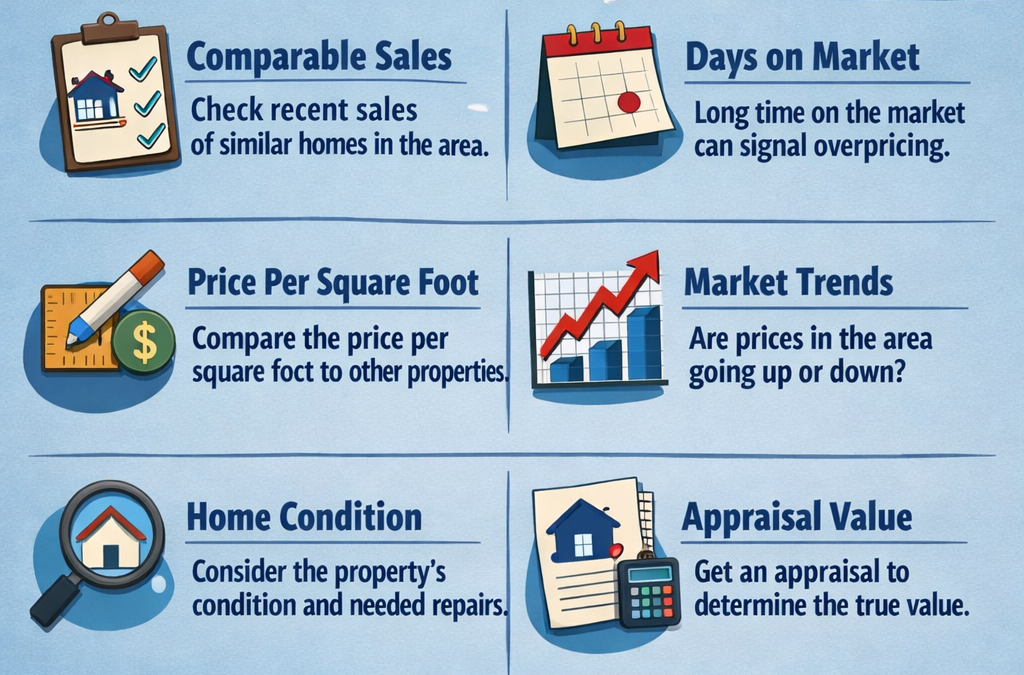
1. Low Interest and Few Showings
- If similar homes nearby are getting multiple showings but the property you’re interested in is barely attracting attention, the asking price might be too high.
- Homes priced right tend to generate steady interest and showings.
2. Long Time on Market (High Days on Market – DOM)
- A home sitting on the market significantly longer than other homes in the neighborhood is often overpriced.
- In a healthy real estate market, well-priced homes sell quickly.
- A high DOM can be a negotiation advantage, signaling the seller may be willing to lower the price.
3. Multiple Price Reductions and Relistings
- Repeated price cuts show the seller initially set the price too high and is trying to adjust.
- Homes that have been taken off the market and relisted multiple times or have expired listings are likely priced incorrectly.
4. Asking Price Far Above Comparable Homes
- If the property’s price is significantly higher than recent comparable sales in the same area, it’s a red flag.
- Even if the home has upgrades, buyers often won’t pay a premium unless the features are widely desirable.
- Customized or niche upgrades rarely justify a much higher price.
5. Online Valuations Significantly Lower
- Automated tools provide estimates of market value.
- If these valuations are much lower than the listing price, investigate the reasons carefully.
6. Emotional Pricing by Sellers
- Sellers may price based on personal attachment, such as the cost of renovations or their plans, rather than market realities.
- The market doesn’t pay for the seller’s dreams or memories; it values what buyers are willing to pay.
7. The “Prettiest” House on a Basic Block
- A home with high-end finishes in a modest neighborhood often won’t recoup the extra cost.
- You might be paying a premium for someone else’s taste, which doesn’t always translate into higher resale value.
How to Use These Signs in Your Home Search and Negotiation
- Watch for these red flags during your home search to avoid overpriced listings.
- Use them as leverage when discussing price with your real estate agent and negotiating with sellers.
- Combine these signs with your comparative market analysis and local market trends to make informed decisions.
- Remember, a home priced correctly will attract multiple offers and sell quickly.
By recognizing these clear signals, you’ll be better equipped to identify overpriced properties and make confident, data-driven offers that protect your investment.
Run Your Home Search With A Target Right Price
To save time and avoid disappointment, set a clear budget and stick to it before you start touring homes. Use filters on listing sites to focus on properties priced within your target range based on your research and comparative market analysis. Avoid homes priced way above others in the neighborhood unless they have unique features that justify the higher cost, as these often stay on the market longer.
Negotiation: When To Low Ball Vs Offer The Right Price
Negotiating the price of a property is both an art and a science. Knowing when to submit a low-ball offer versus when to offer the right price can significantly impact your success in securing the home you want without overpaying. This section delves into the key considerations, backed by data and practical advice, to help you navigate this critical stage of your home search.
Low Ball Only When Data Shows Significant Overpricing
A low-ball offer means proposing a price substantially below the asking price. This strategy should only be employed when your research clearly indicates that the property is overpriced relative to similar homes in the area. Making a low-ball offer without solid evidence can offend sellers and potentially derail negotiations before they begin.
To determine if a property is significantly overpriced, rely on a comparative market analysis (CMA) that compares the listing price with recent sales of comparable homes in the same area. Look for key indicators such as:
- The asking price per square foot is significantly higher than the median of comparable sales.
- The property has been on the market much longer than other properties nearby.
- Multiple price reductions or relistings indicate seller flexibility.
- Online valuation tools show a market value notably lower than the listing price.
If these tell-tale signs point to overpricing, a low-ball offer can be a strategic move to initiate negotiations, especially if you back it up with documented evidence. For example, presenting a detailed CMA report highlighting the price disparities shows the seller you are a prospective buyer who has done their homework and is serious about purchasing.
Offer the Right Price When Comps Support It
In a competitive real estate market, offering the right price—or close to the asking price—is often the best way to secure the property, especially when the seller’s price aligns with recent comparable sales and current market trends. Buyers tend to lose out on homes when they underbid in hot markets where multiple offers are common.
Offering the right price demonstrates respect for the seller’s valuation and can speed up the negotiation process. It is particularly important when:
- The listing price is consistent with the median price of similar homes sold recently.
- The property has received multiple offers or attracted multiple showings.
- The home is in a seller’s market where demand outpaces supply.
- The seller has not made significant price reductions since listing.
In these scenarios, low-ball offers may be ignored or rejected outright. Instead, aim to submit an offer that reflects the true market value based on your research and professional advice from your real estate agent.
Prepare Documentation to Justify Any Low-Ball Offer
If you decide to submit a low-ball offer, preparation is key to increasing your chances of success. Sellers are more likely to consider a lower offer if it is accompanied by clear, objective evidence rather than just a number on paper.
Essential documentation includes:
- Comparative Market Analysis (CMA): A comprehensive report showing recent sales of similar properties, adjusted for size, condition, and location differences.
- Inspection Reports: If a home inspection reveals issues such as roofing problems, outdated systems, or structural concerns, use these findings to justify a lower offer.
- Appraisal Data: An independent appraisal that values the property below the asking price can be a powerful negotiating tool.
- Market Trends Data: Charts or tables illustrating recent price declines or longer days on market for similar homes in the neighborhood.
Presenting this documentation alongside your offer signals professionalism and seriousness. It also helps the seller understand that your offer is based on market realities rather than an arbitrary low figure.
Summary Table: Negotiation Strategies Based on Market Data
| Scenario | Recommended Strategy | Key Considerations |
|---|---|---|
| Property significantly overpriced | Submit a low-ball offer | Back up with CMA, inspections, and appraisals |
| Asking price aligns with comps | Offer close to or at the list price | Avoid losing your home in a competitive market |
| Property has multiple offers or showings | Offer the right price promptly | The seller is likely to reject low-ball offers |
| The seller has made multiple price reductions | Consider a reasonably low offer | The seller may be motivated to negotiate |
| Market favors buyers (buyer’s market) | Low-ball offers more viable | Use market trends and DOM data to justify the offer |
Final Tips for Successful Negotiation
- Communicate Clearly: Work closely with your real estate agent to craft an offer letter that explains your rationale respectfully.
- Be Patient but Firm: Negotiations can take time. Be prepared to counteroffer, but know your maximum price.
- Leverage Market Knowledge: Use insights about market trends, buyer behavior, and local market conditions to time your offer strategically.
- Understand Seller Motivation: Sellers testing the market or with urgent needs may be more open to negotiation.
- Avoid Emotional Decisions: Keep your focus on data and facts to avoid overpaying based on emotional attachment.
By mastering when to low-ball versus when to offer the right price, you position yourself to make informed, confident offers that protect your investment and increase your chances of success in the home-buying process. This is your best defense against costly mistakes and lost opportunities.
Buying with Confidence
At the end of the day, a house is a home, but it’s also the biggest check you’ll ever write. Don’t let the excitement of a “New Home” sign blind you to the math. Successful real estate acquisition is built on asking the right questions—if the numbers don’t add up, don’t be afraid to walk away. There is always another house, but there isn’t always another Php50,000 in your bank account.
Doing your due diligence helps you avoid costly mistakes and find your perfect home at the right price. Remember, in a competitive market, knowledge is your best tool.
HousingInteractive: Your Benchmark for Market Value
We believe that a fair price is the foundation of a great home. As the Philippines’ first property portal, we provide the comprehensive data and professional network you need to cut through the noise. Whether you are analyzing price-per-square-meter or evaluating neighborhood trends, we empower you to see the real value behind the asking price.
HousingInteractive, the Philippines’ first property portal, delivers property solutions that give you the upper hand in negotiations. Before you sign that offer, head over to HousingInteractive to compare listings, consult our experts, and ensure you’re making a move that’s financially sound today!